GPS Jammer Antennas: Helical vs Quadrifilar Helix
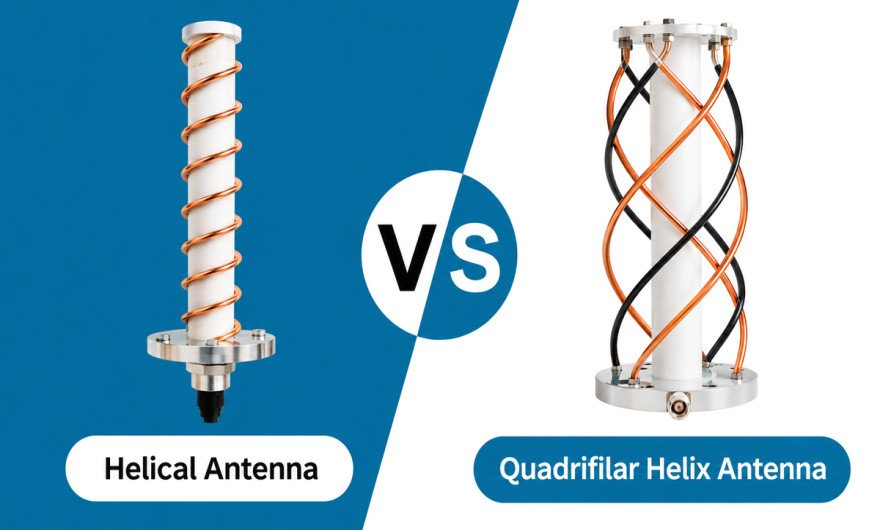
A GPS jammer anti jam antenna from this range is a ground station antenna. The two main designs are: One is the helical. The other is a quadrifilar helix. The helical type is directional. The quadrifilar helix is an omnidirectional type. The choice depends on coverage direction, gain and operating bands. A directional antenna focuses coverage in one direction. An omnidirectional antenna radiates in all directions. Compare models first. Start there.
All GPS jammer anti jam antennas on this site fall into one of two categories. The range comprises directional high gain helix antennas and omnidirectional quadrifilar helix antennas. The next sections compare them in plain terms so you can see which design works for your site.
Helical and Quadrifilar Helix Antennas
Both designs have a spiral shape. The difference is what the signal does. One looks ahead. The other is all around.
Helical Antennas
A high gain helical antenna concentrates coverage in one direction. That gives higher directional gain. It suits cases where coverage needs to stay focused. The AH-1117-11 is rated 11 dBic. The AH-1117-13 is rated 13 dBic. Both cover 1100 - 1700 MHz.
When the required coverage has a defined direction, the directional pattern makes a helical antenna useful. The two AH-1117 models also provide buyers with different gain levels within the same stated frequency range. Compare them and verify the required gain and frequency range against the installation's needs. This helps to avoid model selection based on gain only.
Quadrifilar Helix Antenna
The quadrifilar helix antenna radiates into the surrounding space. This bigger pattern is useful if the signal can come from any direction. It works with circular polarization, same as the helical type. Check out the range of quadrifilar helix antennas for the models.
If the antenna does not have to focus coverage in any one direction, an omnidirectional pattern can be useful. This is different from a directional helical antenna design. If you are choosing between the two, first look at the area of coverage. Compare the system operating bands, gain and polarization requirements.
Directional and Omnidirectional GPS Coverage
There is no one best design in all cases. The right depends on how your site is laid out.
| Feature | Helical Antenna | Quadrifilar Helix Antenna |
|---|---|---|
| Coverage | Directional | Omnidirectional |
| Main use | Focused coverage | Wider surrounding coverage |
| Gain approach | Higher directional gain | Broad coverage |
| Polarization | Circular polarization | Circular polarization |
| Example | AH-1117 series | Quadrifilar helix range |
GPS Bands and Multi-Band Coverage
GPS signals are in several bands. These are GPS L1, L2, and L5. A multi-band antenna has to work on more than one frequency. The product description says the range is made for all GPS bands. This is the reason why buyers often look for an all band GPS antenna. Still verify the frequency range stated for each model. Don't judge coverage by its name alone. You may also find requirements for GLONASS, IRIDIUM and INMARSAT bands. Here are no specific frequencies given. See them on the product page.
Circular Polarization and dBic
Circular polarization means the radio wave spins as it travels. It is widely used in satellite signals. For this type of signal, an antenna with the same polarization is appropriate.
dBic is the gain relative to an ideal circular polarized reference. Compare gain only (in the same units). The AH-1117-11 is 11 dBic. The AH-1117-13 is rated at 13 dBic.
How to Choose a GPS Jammer Antenna
Be sure to follow these points to select a GPS jammer anti jam antenna:
- Required operating bands
- Directional or omnidirectional coverage
- Required gain
- Circular polarization
- Installation location
- Ground control station requirements
- Environmental requirements
All seven have to fit into a GPS ground control station antenna. First compare types. Then compare the models. Gain figures are only useful if they are in the same unit. It only works if coverage points the right way. The frequency range determines all other parameters.
Ground Station GPS Jammer Antennas
Helix antennas are directional and offer targeted coverage. Quadrifilar helix antennas cover all directions. A ground control station antenna should fit your band, polarization and site needs.
The product line is designed to MIL-STD-810G. The information provided makes no further claim. So, check environmental needs against the product page. Do not read more into the standard than what is written on the page.
AH-1117 Helical Antenna
| Model | Antenna Type | Gain | Frequency Range |
|---|---|---|---|
| AH-1117-11 | Helical | 11 dBic | 1100–1700 MHz |
| AH-1117-13 | Helical | 13 dBic | 1100–1700 MHz |
The details begin with the page for the AH-1117-11 helical antenna.
Why Antenna Experts?
Antenna Experts has directional high-gain helix antennas and omnidirectional quadrifilar helix antennas. Multi-band design for all GPS bands, as noted in the product info. We also provide MIL-STD-810G construction. We offer product-level specifications so buyers can compare designs side-by-side. We also assist buyers in choosing between one antenna design and another. The goal is a clear match between antenna and task. When choosing an antenna manufacturer in India, verify the model list and obtain units. Look at the frequency range. Then match them to your site.
Frequently Asked Questions
1. What is the difference between a helical and quadrifilar helix GPS antenna?
Helical antennas in this range are directional in nature. Quadrifilar helix antennas provide omnidirectional coverage. It all depends on what coverage pattern you need. This is true for any GPS jammer anti jam antenna in the range.
2. Which GPS bands can a single jammer antenna cover?
Depends on the frequency range you specify. A single antenna can cover multiple GPS bands if its range can support them. Look at the specs for that specific model. Coverage L1, L2, L5 do not assume.
3. When is an Omnidirectional GPS Jammer Antenna better than a Directional one?
If you need coverage out past the antenna, it helps to have omnidirectional coverage. A directional antenna is good for a single focused direction.
4. Is CRPA anti-jam antenna the same as GPS jammer antenna?
No. The antennas in this range are not CRPA anti-jam arrays. They are GPS jammers and ground station antennas.
About the Author
Gurleen Neyar is Marketing Manager at Antenna Experts. Gurleen writes content on antennas and technical products. Gurleen is also working on marketing for the company. The goal is to clarify technical product information. And then buyers can compare antenna options and get a sense of key specifications before they choose.