High Gain Yagi Antenna: Single, Dual or Quad Stacked
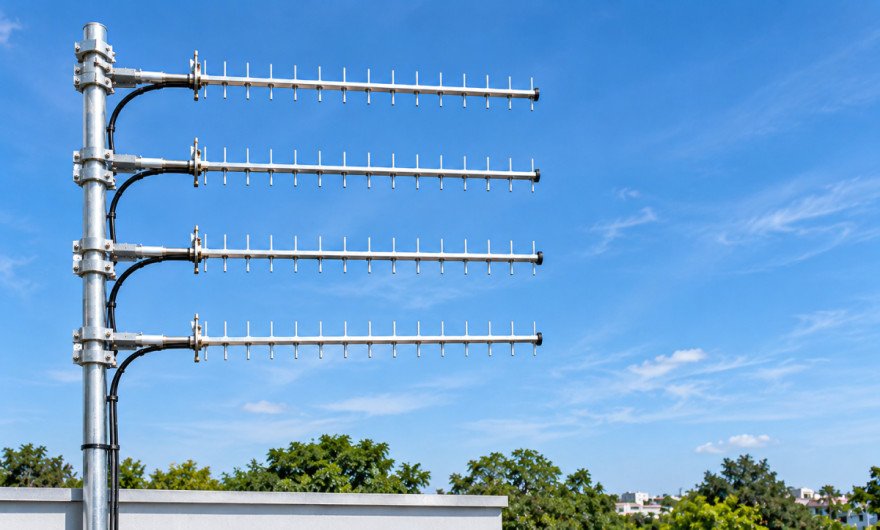
A high-gain yagi antenna directs the signal in one direction. You can select a single Yagi, a dual-stacked Yagi antenna, or a quad-stacked yagi antenna. The big difference is gain. The right choice depends on your band and your link, not just on gain. The supplied VHF models range from 12 dBi for the single Yagi to 17 dBi for the quad stacked model. For UHF, the stated gain ranges from 13 dBi to 18 dBi across the same configurations. However, the highest gain is not automatically the best fit for every link. Here's how each setup works and when to use it. If you are looking to shortlist the best high-gain yagi antenna for use on VHF or UHF, the things to compare are covered below.
Single vs. Dual vs. Quad Stacked Yagi Antennas
One Yagi is one antenna unit. This is the simplest option and the baseline against which to compare.
A high gain dual-stacked Yagi antenna combines two Yagi elements to function as a single array. A quad version adds four. Multiple Yagi antennas can be stacked to form a single directional array with the stated gain. The real gain depends on the antenna design and stacking arrangement so the product specifications are more useful for comparison than a general theoretical figure. The real gain is in spacing and design, so product values are more important than theory. A typical stacked yagi antenna setup involves parts such as a phasing harness and stacking pipe. Check the exact parts on each model’s product page.
Yagi Antenna Gain Comparison
The supplied product specifications show these values:
| Configuration | VHF Model | VHF Gain | UHF Model | UHF Gain |
|---|---|---|---|---|
| Single | AY-150 | 12 dBi | AY-450 | 13 dBi |
| Dual stacked | ADY-150 | 15.5 dBi | ADY-450 | 16 dBi |
| Quad stacked | AQY-150 | 17 dBi | AQY-450 | 18 dBi |
Quad stacked Yagi antenna gain in dBi is a measure of how well the antenna focuses the signal compared to an ideal point source. Going from single to dual adds 3.5 dBi on VHF and 3 dBi on UHF. Moving from dual to quad gives 1.5 dBi on VHF and 2 dBi on UHF. These gaps are not a rule for all Yagis. Gain too does not translate to a set distance or coverage area. See the complete range of high-gain yagi antenna models here.
When Should You Choose Each Configuration?
- Single Yagi: Consider a single Yagi when its stated gain meets the needs of your link and you want the simplest of the three configurations.
- Dual stacked: Consider a dual stacked configuration when you need more stated gain than the corresponding single Yagi. The supplied models provide 15.5 dBi for VHF and 16 dBi for UHF.
- Quad stacked: Consider a quad stacked configuration when the application calls for the highest stated gain among these supplied models, with 17 dBi for VHF and 18 dBi for UHF.
There is not one configuration better than all others. More gain also means more hardware and planning for installation.
VHF vs. UHF Yagi Antennas
The supplied VHF antenna models are AY-150, ADY-150, and AQY-150, all covering 136–174 MHz. The UHF models are AY-450, ADY-450, and AQY-450. The stated gain increases across the single, dual stacked, and quad stacked configurations in both sets of models. The UHF gain specified is slightly higher than the VHF gain at each level. The values provided do not include the UHF frequency range. Before ordering, please check the product page. A beneficial place to start is the AY-450 UHF antenna page.
What to Check Before Choosing a High-Gain Yagi Antenna
- Frequency band: To match your radio system.
- Gain (stated in dBi): Use published value.
- Polarization: Both ends of the link have to agree.
- Horizontal beamwidth: This is the width of the main beam. Does your target direction change? It does matter.
- Front-to-back ratio: This is a measure of how well the antenna can reject signals from behind it. It is contingent upon crowded sites.
- Stacking arrangement: What phasing harness and stacking pipe parts are used.
- Installation: Check mast clearance, support, and cable routing.
No beamwidth or front-to-back ratio figures are given in the values supplied. If you need them, ask for a datasheet.
Why Choose an Antenna Manufacturer in India?
Antenna Experts is trusted antenna manufacturer in India. We provide Yagi antennas for a wide range of frequency bands and gain levels, from single to dual-stacked to quad-stacked. Models like AY-150, ADY-150, and AQY-150 are available for 136–174 MHz, and AY-450, ADY-450, and AQY-450 for UHF applications.
When buyers are looking for a Yagi antenna manufacturer in India, they should pay close attention to ensure that the antenna frequency range, gain and configuration match the actual requirement. Antenna Experts product range has these model level details to make that comparison before an order is placed.
Frequently Asked Questions
1. How much gain does stacking two Yagi antennas add?
For the supplied VHF models, the gain increases from 12 dBi on AY-150 to 15.5 dBi on ADY-150, a difference of 3.5 dBi. For UHF, AY-450 increases from 13 dBi to 16 dBi on ADY-450, a difference of 3 dBi. These differences apply to the listed models and are not a universal rule for every Yagi antenna.
2. Does a quad stacked Yagi antenna need a phasing harness?
Stacked arrays typically need some method of feeding the antennas together. The usual approach is a phasing harness. No exact need for AQY-150 or AQY-450 is described in the supplied information. Refer to the product page for exact specification.
3. Which is the best high gain Yagi antenna for long range UHF links?
There is no single best high gain yagi antenna for all links. The highest declared gain of the supplied UHF examples is 18 dBi for AQY-450. There’s no promise of range here. Choose by your application and verified product specifications.
4. Can a Yagi antenna be mounted for vertical or horizontal polarization?
Sure, the polarization is in the direction of the elements. Vertically mounted elements are vertically polarized. Elements in a horizontal position will radiate horizontal polarization. Match the two ends of the link. For these products, please refer to the supported mounting on the product page.
About the Author
Antenna Experts is a manufacturer and supplier of antennas that offers specialized antenna solutions to telecommunications, defence, and other technical sectors. The company also provides useful information about its products and technical data that can help buyers understand the specifications of the antennas and choose the correct product.